Intent
Advances in technology change the way people communicate, interact and work. Becoming digitally literate mean students develop technological skills and understand how to access online information and learn social responsibility when interacting on social networks and evaluating sources of information. At Bowbrook School, we understand that our children need these different types of skills and technological knowledge to engage with the global community. We believe computing allows children of all abilities to become digitally literate problem solvers. Children will investigate and discover how to be efficient users of technology.

Our Computing curriculum will provide everyone with the opportunity to learn programming, word processing, data handling as well understanding how to be safe while using technology.
Implementation
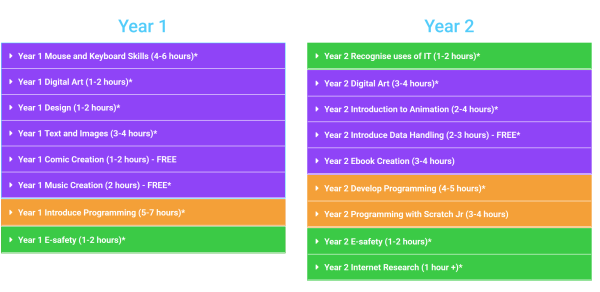
We use the iLearn2 Computing scheme. This curriculum is broken down into three strands: Digital literacy, Information Technology, Computing science.
Digital literacy – Pupils learn to be safe and confident when using technology. Children are supported to feel confident to use technology independently but also understand the risks and dangers of the internet. We want children to be aware of how to combat these concerns safely, to allow us to view technology in a positive light.
Information technology – Pupils experience a wide range of software and hardware to learn and practise transferable skills, which can be used in a range of different programmes. Within this strand, children are able to be flexible and creative in their thinking and experiment with different ideas.
Computing science – Pupils learn how to be computational thinkers. There are four corner stones of this thinking: decomposition, pattern recognition, abstraction, algorithms. This supports children to become resilient problem solvers, developing their ability to break down complex problems, notice similarities and differences, focusing on the important information and developing a logical step by  step solution to the problem at hand.
Computing is not mentioned within the EYFS statutory framework. Despite this, there is still a great deal of computing that goes on in the EYFS classroom at Bowbrook. Within the classroom, children will use iPads regularly. In our setting, children are also exposed to different toys and role-play opportunities that allows children to develop their literacy skills through computing. Children can use technology to play maths games as well as applying their directional language while coding Beebots etc. Within the environment, children use technology to create artwork and music as an enhancement or an alternative medium to physical objects.
Impact
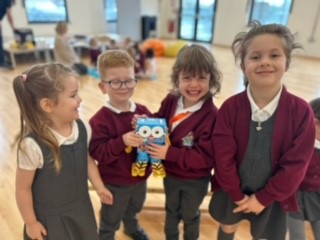
We believe engagement with computing builds resilience, confidence, and creativity to allow children to be effective, safe computational thinkers. The children should be able to provide alternative ways to present and find knowledge in all areas of learning. We expect the children at Bowbrook to be very enthusiastic and proud of their computing development and be always keen to share their learning.
Progression Of Skills
Long term plans: