Intent, Implementation, and Impact
Intent
Reading is the golden thread of learning! We intend for each of our students to learn to read fluently (accurately, speedily and with prosody), as quickly as possible so they are able to build the bridge between word recognition and comprehension. This is essential for children to access all other areas of the curriculum and is the reason why reading is a vital part of our curriculum at Bowbrook Primary.
We want children to love reading as soon as possible and to continue and develop an appreciation and love of reading throughout their learning journey. We share high quality and vocabulary-rich texts across the curriculum as the teaching of reading is essential in giving the children a toolkit to access information, share in cultural experiences and be able to express themselves in a variety of situations.
Implementation
At Bowbrook Primary, we promote a phonics first approach. We believe that phonics is fundamental in helping children build the necessary foundations to develop into fluent, confident and passionate readers. We use Unlocking Letters and Sounds as it offers precise structure and a ‘whole class mastery’ opportunity.
Phonics is introduced in Nursery. Phase One will be introduced under 7 aspects:
General sound discrimination – environmental sounds
General sound discrimination – instrumental sounds
General sound discrimination – body percussion
Rhythm and rhyme
Alliteration
Voice sounds
Oral blending and segmenting
There is considerable overlap between these aspects, however, the overarching aim is for children to experience regular, planned opportunities to listen carefully and talk extensively about what they hear, see and do. The boundaries between each strand are flexible and not fixed. Our teachers will plan to integrate the activities according to the developing abilities and interests of the children in the setting
In Reception, we ensure enough time and priority are given to fully implement our Phonics programme. Children in EYFS and Year 1 have 5x weekly phonics session for approximately 20 minutes. However, the teaching extends beyond ‘dedicated time’ and is applied and reinforced when appropriate throughout day.
Children are taught as a whole class and assessments are carried out summatively and formatively as taught with instant verbal feedback. Interventions are in place to support children who require further consolidation of sounds following regular assessments.
The structure of each session is as follows:
- Revision and review of prior knowledge e.g., prior phoneme
2. Introduction and modelling of new phoneme through teaching
3. Practise of new phoneme
4. Application of new phoneme to segment for themselves or blend in whole sentences.
In Year 2, children who did not pass the phonics screening at Year 1 or need further consolidation, will continue with the structure of phonics sessions that were delivered in Year 1. All children in Year 2, get access to the consolidation of previous phases and phase 6.
There may be a need for children to be taught using a whole word reading approach depending on specific needs. This will be following discussions with the class teacher and the Special Educational Needs co-ordinator.
We have clear progression for our programme: (see progression document)
Using this programme, we are confident that:
- grapheme/phoneme (letter/sound) correspondences are taught in a clearly defined, incremental sequence;
• we introduce children very early on to a defined initial group of consonants and vowels, enabling them to read and spell as soon as possible many simple CVC words;
• children are taught the highly important skill of blending phonemes, in order, all through a word to read it;
• children are taught to apply the skills of segmenting words into their constituent phonemes to spell; blending and segmenting are reversible processes.
We closely monitor children not making expected progress. Children who are working under expected levels, are swiftly identified and additional support is provided to enable them to keep up. We give catch up support by providing group interventions. The content of these sessions is determined by ongoing gap analyses and knowledge of each child. Children experiencing significant difficulty are provided with intensive, individual support to reach the required standard.
There may be the requirement for Phonics to be taught beyond Year 2 depending on individual needs.
Reading books
Children in Nursery will share various story books and non-fiction books with an adult. When they go into Reception, they will practise early reading with fully decodable books. Reading books in EYFS and Year 1 are:
- matched to phonic knowledge;
• are closely matched to the programme used primarily Ransom Reading Stars to ensure complete fidelity to the ULS progression;
• are fully decodable at child’s current level and practise phoneme(s) most recently taught
• are not mixed with non-decodable books for independent reading practice
• include a controlled, small number of ‘common exception words’ that are explicitly taught
• are continued in progressive sequence until a child can confidently decode words involving most common grapheme representations of all phonemes.
Once children are able to decode and are confident with all of the Phase 5 phonemes, they will move on to our Reading Planet book scheme. This will typically begin at the end of Year 1/ beginning of Year 2. From Year 2 children will have a structured approach with coloured bands until they become a free reader.
Guided Reading
High quality book talk begins in Nursery but explicit teaching of reading comprehension takes place from Reception. This takes the form of small, guided reading group using a high quality text which follows a consistent structure which supports their phonics learning. Texts are carefully selected by teachers to ensure progression and breadth of coverage. Guided Reading will look different in Reception and Year 1 to the rest of the school in line with our Phonics scheme.
Guided Reading will:
´ involve a dialogue between the teacher or teaching assistant and the children for the purpose of jointly constructing the meaning from text;
´ be a group activity – the adult initially leads the group with effective reading strategies
´ be interactive and suitable for all readers including children with SEND;
´ include various strategies such as: prediction, clarification, questioning and summarising.
Fostering a Love of Reading
The following strategies and initiatives are used to encourage reading and to develop the love of reading in our school:
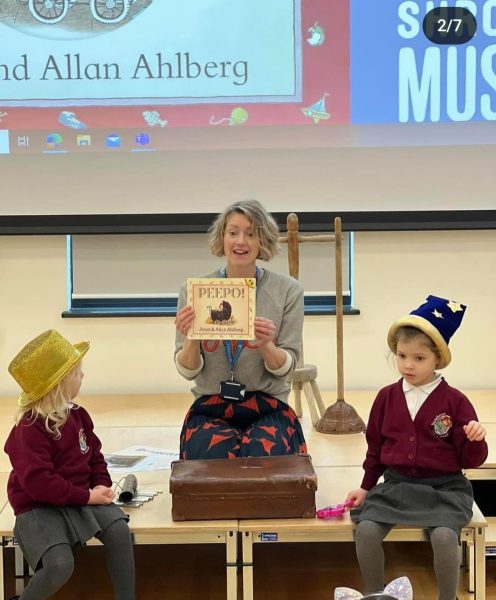
- Dedicated book-talk and library sessions
• Play and exploration
• Drama, choral speaking, and performances
• Guided reading
• Daily class reader
• Reading spots and a library stocked with high-quality texts
• Visits from authors and performers
Reading at Home
We believe the most important support parents can provide for their children is reading with and to them. Every child from Reception will have a book matched to their phonics level and a book to read for pleasure.

Here are some ideas as to how parents can help their child:
- Help them with their phonics sounds as they read
• Read to them; model how a story should be read with exciting pitch, tone, pause, punctuation and character voice
• Read a range of different types of text and explain how they are different
• Discuss what they are reading: ask questions about what might happen next and about what has already happened
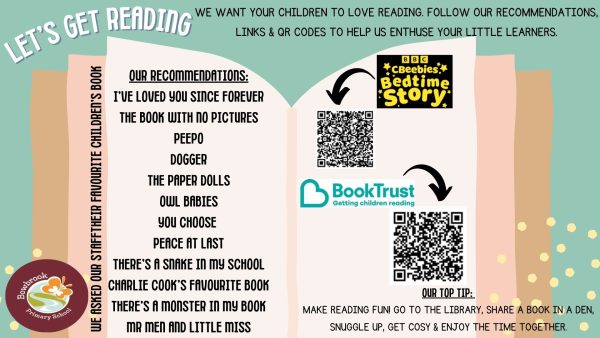
• Share your favourite books
• Visit the Library and bookshops
• Make time for stories as often as you can. Story time can be a very special time for children and the parents/carers to share together.
Parents are helped to know how best to support their child in learning sounds by carrying out parent workshops and information on our website. Through this, parents understand how to work appropriately with decodable books and with reading for pleasure books.
Parents/guardians will need to sign the diaries to show that they are aware of their child’s reading. An adult from the class will then check this on a weekly basis and children who are not reading on a regular basis will take part in catch-up sessions to ensure they are not falling behind their peers.
Impact
By the end of Reception children will reach the expected level in Reading to achieve the Early Learning Goal.
By the end of Year 1 we expect our children to have progressed well enough with their phonics to pass the Phonics screening test.
The expectation is that all children will be fluent readers having secured word recognition skills by the end of key stage one.
By the end of Year 2, we expect our children to be skilled at word reading to ensure:
- the quick working out of unfamiliar printed words (decoding); decode most new words outside their spoken vocabulary, making a good approximation to the word’s pronunciation;
• the quick recognition of familiar printed words; read books at an age-appropriate interest level, accurately and at a reasonable speaking pace;
• books at an age-appropriate interest level are read at a speed that is sufficient for them to focus on understanding what they read rather than on decoding individual words;
• most words are read effortlessly and children are able to work out how to pronounce unfamiliar written words with increasing automaticity.
Decoding fluently and accurately by the end of Year 2 means that no further direct teaching of word reading skills (with the exception of vocabulary development) should be needed for the majority of children at our school.
In addition, we expect our children to:
• Have a love of reading that feeds the imagination;
• Read widely across both fiction and non-fiction, developing knowledge of themselves and the world in which they live;
• Have a developed vocabulary beyond that used in everyday speech;
• Understand nuances in vocabulary choice;
• Understand age-appropriate, academic vocabulary.
Phonics progression
READING progression
Learning phonics simple flyer